Painting

Having given in the preceding pages the briefest possible outline of the life of Watts as a man amongst men, we are now able to come to closer quarters. He was essentially a messenger—a teacher, delivering to the world, in such a manner that his genius and temperament made possible, ideas which had found their place in his mind. He would have been the first to admit that without these ideas he would be less than nothing.

Failing the "Progress of the Cosmos," we have from the mind and brush of Watts a great number of paintings, which may be grouped according to their character. Such divisions must not be regarded as rigid or official, for often enough a picture may belong to several groups at the same time. For the purpose of our survey, however, we divide them as follows:

by William Loftus Hare

A familiar figure in classic mythology was that of the little god of love, Cupid. He was the son of Venus, and, like her, was concerned in the affairs of the heart. Ancient art represented him as a beautiful naked boy with wings, carrying a bow and quiver of arrows, and sometimes a burning torch. The torch was to kindle the flame of love, and the arrows were to pierce the heart with the tender passion. These missiles were made at the forge of Vulcan, where Venus first imbued them with honey, after which Cupid, the mischievous fellow, tinged them with gall.

Miss Anne Bingham was one of the many aristocratic ladies whose portraits Reynolds painted, and one of the most interesting of this class of sitters. Her vivacious face looking into ours wins us at once, and we should be glad to know more of the charming original.

Village life in England before the time of railroads had a picturesque charm which it has since lost except in remote districts.

The eccentric figure of Dr. Samuel Johnson was one of the familiar sights of London during the middle of the eighteenth century. He was a man of great learning, a voluminous writer, and an even more remarkable talker. He was born in 1709, and, the son of a poor bookseller, he struggled against poverty for many years. Literary work was ill paid in those days, and Johnson gained his reputation but slowly.

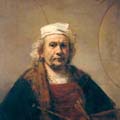
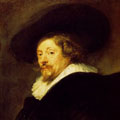
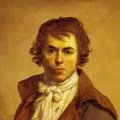
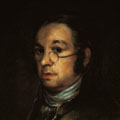
In the city of Florence, Italy, there is a famous gallery of portraits unlike any other collection of pictures in the world. It consists of the portraits of artists, painted by their own hands, and includes the most celebrated painters of all nations, from the fifteenth century to the present time. Here may be seen the portraits of Velasquez, Titian, Tintoretto, Rembrandt,—the world's greatest portrait painters,—and in the same splendid company hangs the portrait of Reynolds, reproduced in our frontispiece.

by Estelle M. Hurll

The name of Sir Joshua Reynolds holds a place of honor among the world's great portrait painters. To appreciate fully his originative power one must understand the disadvantages under which he worked. His technical training was of the meagrest kind, and all his life he was hampered by ignorance of anatomy. But on the other hand he combined all those peculiar qualities of the artist without which no amount of technical skill can produce great portrait work.

Syndicate content