Painting

Ever since the beginning of human history there have been people who puzzled their brains about the reasons of things. Why things are as they are, whence we came, and whither we are going are some of the perplexing questions they have tried to answer. Some men have given all their lives to the study of these problems as a single occupation or profession. Among the ancient Greeks, who were a very intellectual nation, such men were quite numerous and were held in great esteem as teachers.

by Mortimer Menpes

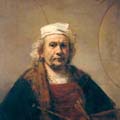
Although I am familiar with Rembrandt's work, through photographs and black and white reproductions, I invariably experience a shock from the colour standpoint whenever I come in touch with one of his pictures. I was especially struck with that masterpiece of his at the Hermitage, called the Slav Prince, which, by the way, I am convinced is a portrait of himself; any one who has had the idea suggested cannot doubt it for a moment; it is Rembrandt's own face without question.

Imagine a man, a citizen of London, healthy, middle-aged, successful in business, whose interest in golf is as keen, according to his lights and limitations, as the absorption of Rembrandt in art. Suppose this citizen, having one day a loose half-hour of time to fill in the neighbourhood of South Kensington, remembers the articles he has skimmed in the papers about the Constantine Ionides bequest: suppose he strolls into the Museum and asks his way of a patient policeman to the Ionides collection.

Suppose our citizen and golfer, deliberately dropped in the preceding chapter, had a child, a son, who by a freak of heredity was brooding and imaginative, fond, in a childish way, of pictures and books, but quite indifferent to scientific criticism and the methods of the analytic men. During his school holidays his mother would take him to the pantomime, and to the National Gallery. Dazed, he would scan the walls of pictures, wondering why so many of them dealt with Scriptural subjects, and why some were so coloured, and others so dim.

The citizen and golfer, whose commerce with Rembrandt was narrated in the first chapter, approached the master through the writings of his Recoverers, certain art historians and scholars, who frequent libraries, search archives, and peruse documents; men to whom a picture is a scientific document rather than an emotional or intellectual experience. He was well content to end his commerce with Rembrandt there. History interested him: to art he was apathetic.

Suppose the admiration of our enthusiast for Rembrandt had been noted in the select suburb where he lived: suppose his mother was one of those estimable ladies who hold monthly Dorcas meetings in their drawing-rooms: suppose that while the ladies were working at useful garments for the poor, she persuaded her son to discourse on Rembrandt: suppose, because the petition came from his mother that he, very much against his will, consented.

It is generally acknowledged that the greatest masters of painting that the world has known are Titian, Velasquez, and Rembrandt, and to each of the triumvirate we apply the word genius. Among the many definitions of that abused word is one which states that genius consists not in seeing more than other people, but in seeing differently. We acknowledge genius in a painter when, over and above masterly technical power, he presents to us a view of life or of nature which we may never have seen, but which we are convinced is the vision of deeper eyes than our own, and is true.

Science has long been trying to solve the problem of the origin of the human race. Great books are published by learned men to explain how the being called man came to be what he is. But centuries before the beginnings of science a wonderful poem was written on the same subject of the creation. This poem is called Genesis, that is, the Birth or Origin of things, and it forms a part of the first book of our Bible. Ever since it was written it has been one of the sacred books of many people.

Syndicate content